
In the modern automotive electronic architecture, wire harnesses are the “nervous system.” To balance conductivity, flexibility, and mechanical strength, conductors are rarely solid wires; instead, they are manufactured through a stranding process.
As traditional pure copper wires face challenges in space constraints and high-frequency signal integrity, Copper Clad Steel (CCS) stranded wires are becoming the industry’s preferred choice due to their unique physical properties.
01 What is Wire Stranding?
Stranding is the process of twisting multiple small-diameter filaments into a larger conductive core according to specific rules.
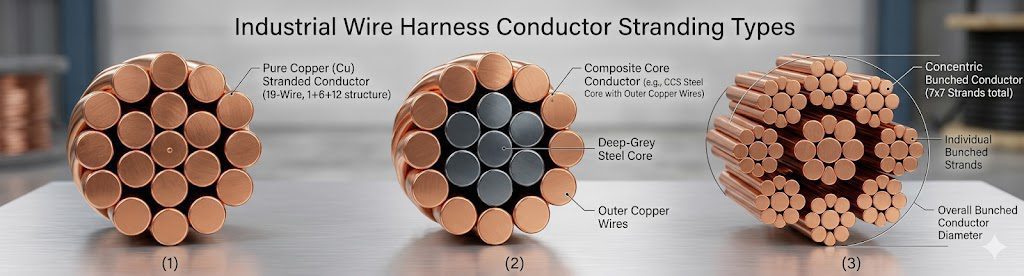
- Concentric Stranding: Filaments are arranged in regular layers with alternating directions, providing the most stable structure.
- Bunching (Irregular Stranding): The most common method for automotive harnesses. Multiple filaments are twisted in the same direction at high speed.
- Why use Bunching for cars? It allows for a large sliding margin between filaments, offering superior flexibility for installation in tight engine bays or door hinges.
02 The “Cross-over” Advantages of CCS in Stranding
While traditional stranding uses pure copper, Copper Clad Steel (CCS) stranded wires promoted by FISSOT combine the conductivity of copper with the strength of steel:
- Superior Mechanical Strength: At the same cross-section, CCS stranded wire has a much higher tensile strength than pure copper. This prevents breakage during high-speed automated assembly and vehicle vibration, enhancing reliability.
- High-Frequency Performance (Skin Effect): For high-speed data transmission in vehicles, current flows primarily on the surface. The outer copper layer of CCS provides excellent conductivity, while the steel core adds structural integrity.
- Fatigue & Vibration Resistance: CCS exhibits better fatigue resistance under constant automotive vibration, significantly extending the service life of the harness.
03 Key Technical Terms
- Pitch: The longitudinal distance for one full rotation of a filament. A smaller pitch means higher flexibility.
- Lay Direction: Categorized as Left-hand (S) or Right-hand (Z).
- Compaction: Compressing the stranded core to create a smooth, round surface, reducing the outer diameter to save critical space in the vehicle.
04 Conductor Classification
According to the GB/T 3956 standard, conductors are divided into four classes:
- Class 1 & 2: Solid or standard stranded, for fixed installations.
- Class 5 & 6: Specifically for flexible cables. Automotive harnesses typically use Class 6 conductors because of their finer filament diameters and tighter stranding, providing top-tier flexibility.
Conclusion
As a leader in advanced materials, FISSOT provides high-quality Copper Clad Steel (CCS) and bimetallic stranding solutions. Choosing the right stranding process and advanced CCS materials is the key to ensuring safety, efficiency, and lightweighting in modern automotive circuits.