
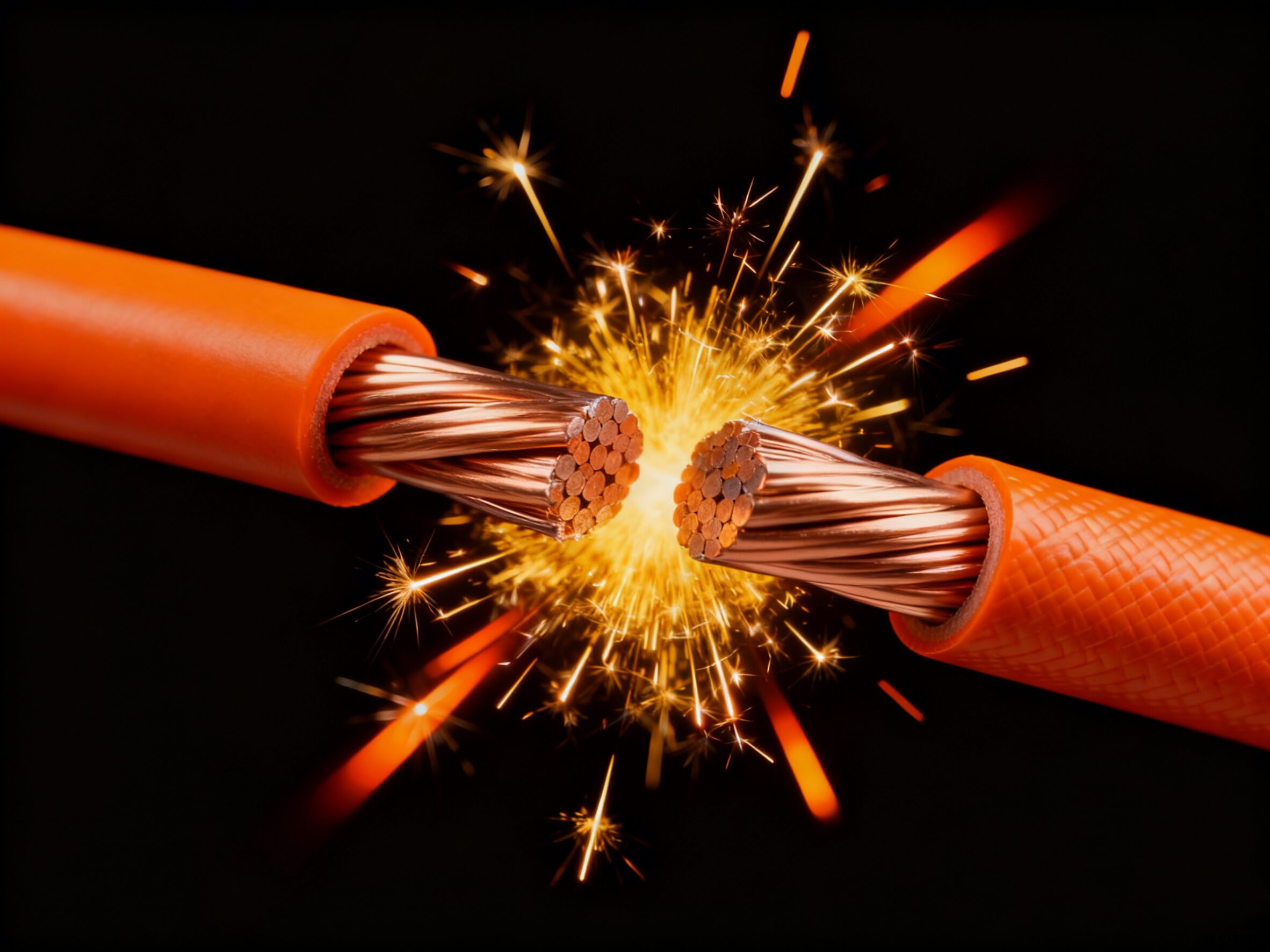
The Choice Between CCS and Pure Copper
The choice between Copper Clad Steel (CCS) and pure copper is a classic engineering trade-off between a homogeneous element and an optimized composite.
- Pure Copper is the conductivity benchmark (~100% IACS), conducting efficiently through its entire cross-section at DC and low frequencies.
- Copper Clad Steel has a high-strength steel core clad with a copper layer. Its overall DC conductivity (30-70% IACS) is lower than pure copper, but this changes dramatically at high frequencies.
The Game Changer: High Frequency and the Skin Effect
The skin effect causes AC current to concentrate near a conductor’s surface at high frequencies. The skin depth becomes incredibly small (e.g., ~0.0021 mm at 1 GHz).
This is the reason for the existence of Copper Clad Steel. At high frequencies, current flows almost entirely within the copper cladding. If the cladding is thicker than the skin depth, the high-frequency AC resistance of CCS can be nearly identical to that of a solid copper conductor. The steel core, carrying little current, provides immense mechanical strength at minimal electrical penalty.
Key Frequencies:
- >5 MHz: CCS attenuation becomes less than copper coaxial cable
- >1000 MHz: CCS attenuation is approximately half that of copper wire
- Skin depth at 1 GHz: ~0.0021 mm
💡 Deep Dive:CCS for RF Coaxial Cables: Complete Technical Guide 2026 – Comprehensive technical guide on CCS applications in RF systems
Head-to-Head Comparison
The following table summarizes the key differences and trade-offs between the two materials across critical parameters.
| Feature | Pure Copper | Copper Clad Steel | Practical Implication |
|---|---|---|---|
| DC / Low-Frequency Conductivity | Excellent (~100% IACS) | Good to Fair (30-70% IACS) | Both suitable for power transmission, DC buses, and low-frequency magnetics |
| High-Frequency AC Conductivity | Excellent | Comparable (when skin depth < cladding) | CCS attenuation < copper coaxial cable (>5 MHz); at >1000 MHz, CCS attenuation = ½ of copper wire |
| Tensile Strength | <400 MPa | 1300 MPa | Pure copper wires frequently break during construction/operation; CCS offers 3.25× strength |
| Density (g/cm³) | 8.9 | 7.9 (20% conductivity) / 8.2 (40% conductivity) | CCS provides weight reduction for tension-critical installations |
| Material Cost | High | ~40% lower | CCS conserves scarce copper resources while reducing material costs |
| RF Radiation | Standard | Higher power radiation | CCS radiates more power than pure copper under high-frequency influence |
| Corrosion Resistance | Good | Excellent | CCS dual-layer design provides superior corrosion protection. See: Does Corrosion Affect the Performance of CCS? |
Application-Driven Conclusions
Where CCS Excels ✅
In RF and Microwave systems, CCS is often the optimal choice:
- Coaxial cable center conductors – Premium cables up to millimeter-wave frequencies
- Antenna elements and radials – Superior mechanical integrity for outdoor installations
- High-tension installations – Wind loading, ice loading resistance
- Broadcast and telecommunications – Long-span aerial wires
💡 Key Advantage: CCS provides necessary mechanical integrity without sacrificing RF performance. The skin effect ensures current flows in the copper layer while the steel core provides structural support.
Where Pure Copper Excels ✅
In applications where current utilizes the full conductor cross-section:
- Low-frequency power applications (<5 MHz)
- High-current busbars – Maximum conductivity minimizes energy loss
- Audio equipment – Superior signal fidelity
- DC power transmission – Battery cables, grounding systems
💡 Related Reading:Automotive Wire Conductor: CCS Benefits – How CCS creates value in automotive wiring harnesses
Decision Framework: How to Choose
Ask Yourself:
├─ Is this a HIGH-FREQUENCY application (>5 MHz)?
│  ├─ YES → CCS is likely optimal (skin effect works in your favor)
│  └─ NO → Continue below
│
├─ Is MECHANICAL STRENGTH critical? (tension, wind, ice loading)
│  ├─ YES → CCS (1300 MPa vs <400 MPa)
│  └─ NO → Continue below
│
├─ Is COST a major constraint?
│  ├─ YES → CCS (~40% cost savings)
│  └─ NO → Continue below
│
├─ Is CORROSION RESISTANCE critical?
│  ├─ YES → CCS (dual-layer protection)
│  └─ NO → Continue below
│
└─ Is ULTIMATE CONDUCTIVITY the sole priority?
   ├─ YES → Pure Copper
   └─ NO → CCS offers better engineered solution
Summary: It’s About Optimization
| Pure Copper | Copper Clad Steel | |
|---|---|---|
| Champion of | Absolute, bulk electrical conductivity | Optimized, application-specific performance |
| Strategy | Maximum conductivity | Strategic trade-off: conductivity ↔ strength + weight + cost |
| Best Use | Ultimate electrical efficiency is the sole priority | Specific electrical, mechanical, and economic requirements |
| Frequency Range | DC to low-frequency (<5 MHz) | High-frequency (>5 MHz) to millimeter-wave |
| Tensile Strength | <400 MPa | 1300 MPa (3.25× stronger) |
| Cost Efficiency | Standard | ~40% savings |
Pure copper is the champion of absolute, bulk electrical conductivity. Use it where ultimate electrical efficiency is the sole priority.
Copper clad steel is the champion of optimized, application-specific performance. It strategically trades some bulk conductivity for exceptional strength, reduced weight, and lower cost, while preserving excellent surface conductivity at high frequencies.
The choice is not about a “better” material, but about the better engineered solution for your specific electrical, mechanical, and economic requirements.
Key Takeaways Summary
The fundamental difference between Copper Clad Steel (CCS) and pure copper represents a classic engineering optimization: homogeneous maximum conductivity versus composite application-specific performance. Pure copper (~100% IACS) excels in DC power transmission, low-frequency applications, and high-current busbars where current utilizes the full conductor cross-section. However, CCS dominates high-frequency applications (>5 MHz) due to the skin effect—current concentrates near the surface, flowing almost entirely within the copper cladding when thickness exceeds skin depth (~0.0021 mm at 1 GHz). This enables CCS to deliver comparable high-frequency AC resistance while providing three critical advantages: 1300 MPa tensile strength (vs <400 MPa for copper), reduced weight (7.9-8.2 g/cm³ vs 8.9 g/cm³), and ~40% cost savings. CCS is optimal for RF/microwave systems, coaxial cables, and antenna elements requiring mechanical integrity under tension, wind, and ice loading. Pure copper remains essential for low-frequency power applications where ultimate electrical efficiency is the sole priority. The choice isn’t about a “better” material—it’s about selecting the better engineered solution for your specific electrical, mechanical, and economic requirements.
Related Articles from FISSOT
| Article | Focus | Link |
|---|---|---|
| What is CCS | CCS fundamentals | Read |
| Electrical Conductivity: CCS vs Pure Copper | Conductivity comparison | Read |
| CCS for RF Coaxial Cables: Complete Technical Guide 2026 | RF applications | Read |
| Does Corrosion Affect the Performance of CCS? | Corrosion resistance | Read |
| Automotive Wire Conductor: CCS Benefits | Automotive applications | Read |
| CCS: A Versatile Composite Material | Material properties | Read |
| New Applications for CCS and CCA Wires | Latest applications | Read |
| Selection and Application of Low-Voltage Wiring Harness Conductors in Automobiles | Automotive conductor guide | Read |