
Executive Summary
Corrosion represents a universal challenge for metallic materials. However, copper-clad steel (CCS) stands out with its unique dual-layer design, delivering exceptional corrosion resistance. This comprehensive analysis examines CCS performance in corrosive environments, addresses engineers’ most pressing concerns, and provides actionable selection guidelines.
Key Takeaways for Engineers
Core Technical Points
Standards Compliance: FISSOT products meet IEC 62561 and UL 467 grounding material standards.
Material Innovation: FISSOT offers customizable copper layer thickness from 0.254mm to 0.8mm, significantly exceeding the industry average of 0.2mm.
Corrosion Resistance Mechanism: Interestingly, patina formation actually enhances corrosion resistance. Furthermore, when steel core is exposed, surface rust creates a natural protective barrier.
Application Scenarios: Recommended for grounding systems, lightning protection, marine environments, and other high-corrosion-risk applications.
Selection Guidelines: Consequently, always choose products with IEC and UL certifications, and pay close attention to copper layer bonding specifications.
1. Common Corrosion Questions Answered
Q1: What Happens If Copper Corrodes and Exposes the Steel Core?
Answer: The copper-clad steel conductor design ensures that the copper layer occupies most of the exposed surface area. Specifically, this configuration positions copper on the outer surface, where it contacts soil, air, and connectors.
Copper’s Protective Mechanisms
| Characteristic | Description |
| High Conductivity | Ensures efficient current transmission |
| Superior Corrosion Resistance | Acts as a shield for the steel core |
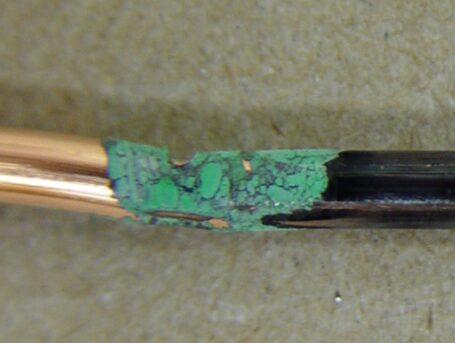
| Patina Formation | Copper does oxidize over time and turns green; however, this patina actually enhances corrosion resistance and extends CCS service life |
Special Circumstances
Nevertheless, certain exceptional conditions exist. Specifically, soil conditions containing cinder fill can accelerate copper corrosion. Fortunately, these situations remain exceptions rather than the norm. In most environments, copper corrodes at an extremely slow rate.
Reference Standard: IEC 62561-2 Lightning Protection System Components Standard
Q2: What If Steel Becomes Exposed Due to Impact or Scratching? Will Corrosion Cause Premature Failure?
Answer: During actual field construction or application, copper-clad steel may experience steel exposure due to impact, scratching, or improper installation.
Steel’s Self-Protection Mechanism
When steel becomes exposed due to copper layer damage, several protective processes occur:
- First, the surface rapidly forms a dense rust layer
- Subsequently, this rust layer acts as a natural barrier
- Moreover, it effectively prevents further corrosion propagation
Impact Scope
Even under the most extreme conditions, corrosion affects only a small portion of the steel surface. Typically, the affected area is limited to 2-3 times the wire diameter.
Overall Performance Impact
More importantly, even when local steel experiences corrosion, the overall performance of the copper-clad steel wire remains largely unaffected.
| Performance Aspect | Status |
| Copper Layer | Remains intact |
| Conductivity | Maintained |
| Operating Condition | Wire continues functioning normally along its entire length |
Q3: How Does Copper-Clad Steel Perform in Marine Environments?
Answer: Marine environments present high corrosion risks. However, FISSOT copper-clad steel, through specialized treatments, proves fully capable for such applications.
Marine Environment Adaptability
| Challenge Factor | Impact Level | Mitigation Strategy |
| Salt Spray Corrosion | ⭐⭐⭐⭐⭐ | Add anti-corrosion coating or tin plating |
| Humid Environment | ⭐⭐⭐⭐ | Natural copper layer protection |
| UV Radiation | ⭐⭐⭐ | Automatic protection after patina formation |
Product Recommendation: FISSOT tin-plated copper-clad steel is ideal for offshore platforms, coastal power stations, and similar scenarios.
Q4: What Is the Expected Service Life of Copper-Clad Steel in Corrosive Soils?
Answer: Under normal soil conditions, FISSOT copper-clad steel delivers an expected service life of 30-50 years.
Service Life Comparison Across Different Soil Conditions
| Soil Type | Corrosion Level | Expected Service Life | Recommended Measures |
| Neutral Soil (pH 6-8) | Low | 40-50 years | Standard products sufficient |
| Acidic Soil (pH <6) | Medium | 25-35 years | Add anti-corrosion coating |
| Alkaline Soil (pH >8) | Medium | 30-40 years | Standard products + regular inspection |
| Saline-Alkali Soil | High | 20-30 years | Tin plating + cathodic protection |
| Cinder Fill Soil | Extremely High | 15-20 years | Special anti-corrosion treatment + frequent inspection |
2. Corrosion Resistance Performance Analysis
2.1 Why Does the Copper Layer Provide Superior Corrosion Protection?
Although corrosion can potentially affect copper-clad steel wire, modern CCS designs have thoroughly addressed anti-corrosion considerations.
Protective Functions of the Copper Layer
| Advantage | Explanation |
| Copper’s Inherent Resistance | Copper itself exhibits good corrosion resistance, especially in atmospheric environments |
| Isolation Effect | The copper layer effectively isolates the steel core from external environments |
| Corrosion Delay | Significantly delays corrosion onset, protecting the steel core from deterioration |
Electrochemical Principle: Copper’s standard electrode potential (+0.34V) is higher than steel’s (-0.44V). Therefore, in a corrosion cell, copper acts as the cathode and receives protection. This characteristic enables the copper layer to remain stable over extended periods.
2.2 How Do Modern Coating Technologies Enhance Corrosion Resistance?
Advances in Coating Technology
| Technical Advancement | Description |
| Advanced Processes | Modern CCS wire typically employs advanced electroplating or cladding processes |
| Tight Bonding | Ensures metallurgical bonding between copper layer and steel core, rather than simple mechanical cladding |
| Reduced Penetration | Dense copper layer structure minimizes the possibility of corrosive medium penetration |
FISSOT Process Advantage: Our continuous cladding, welding, and drawing process achieves molecular-level bonding between copper layer and steel core, with copper layer uniformity deviation <3%.
2.3 What Special Treatments Are Available for Harsh Environments?
Adaptive Treatments for Application Environments
| Special Treatment | Effect | Applicable Scenarios |
| Enhanced Anti-Corrosion Coating | Further improves corrosion resistance | Marine environments, chemical plants |
| Alloy Material Adoption | Enhances tolerance to specific media | Acidic soils, industrial zones |
| Tin Plating Treatment | Improves welding performance and corrosion resistance | Grounding systems, electrical connections |
| Cathodic Protection | Active corrosion prevention | Buried pipelines, submarine cables |
3. Selecting High-Quality Copper-Clad Steel
⚠️ Important: How to Identify Inferior Copper-Clad Steel Products?
Not all copper-clad steel products meet the same standards. Consequently, understanding quality differentiation is critical.
Risks of Inferior Products
| Risk Factor | Consequence | Identification Method |
| Cracks and Gaps in Copper Layer | Moisture flows between steel and copper layer | Microscopic inspection, bending test |
| Insufficient Copper Layer Thickness | Significantly reduced corrosion-resistant service life | Eddy current thickness gauge |
| Poor Bonding | Copper layer easily peels off, exposing steel core | Torsion test, impact test |
| No Authoritative Certification | Performance not guaranteed | Verify IEC, UL certificates |
Ultimately, inferior products may lead to premature performance failure, excessive grounding resistance, and increased safety hazards.
Selection Recommendations
✅ Choose high-quality products with IEC and UL certifications
✅ Pay attention to copper layer thickness (recommended ≥0.254mm) and bonding specifications
✅ Select appropriate anti-corrosion treatments based on usage environment
✅ Avoid inferior products with cracks and gaps
✅ Prioritize reputable brands such as FISSOT
4. FISSOT Copper-Clad Steel Series (IEC & UL Certified)
4.1 Key Technical Specifications
| Parameter | Specification |
| Tensile Strength (Vertical Grounding) | 350-770 MPa |
| Tensile Strength (Horizontal Grounding) | 290-510 MPa |
| Copper Layer Thickness | 0.254mm-0.8mm (customizable) |
| Conductivity | ≥19% IACS |
| Operating Temperature Range | -40℃ to +150℃ |
| Expected Service Life | 30-50 years (normal environment) |
Certification Standards
- IEC 62561-2 – Lightning Protection System Components
- UL 467 – Grounding and Bonding Equipment
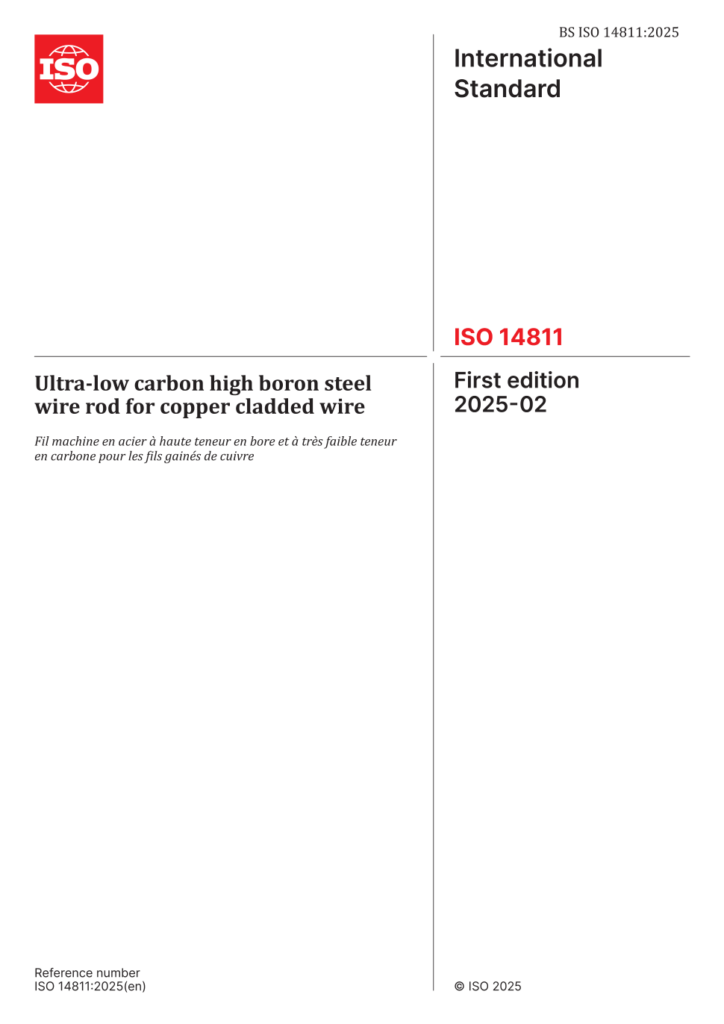
- ISO 14811:2024 – Ultra-Low Carbon High-Boron Steel Wire for Copper-Clad Steel
4.2 How Is Corrosion Resistance Verified Through Testing?
Performance Testing Protocols
(1) Copper Layer Ductility Test
- Test Method: Product bent 90° three consecutive times
- Pass Standard: No cracks on inner or outer edge copper layer
(2) Copper Layer Bonding Test
- Test Method:
- Place product between fixture or vise jaws with spacing less than specimen steel core diameter (W=d-0.1)
- Strike specimen end with hammer
- Cut away sufficient copper layer to fully expose steel core
- Pass Standard:
- ✅ Copper layer flaking allowed at vise jaw location
- ✅ No visible rod remainder, copper flaking, or steel exposure with naked eye
(3) Electrical Corrosion Performance Test
- Test Method: Simulate fault current release through electrical corrosion cycle testing
- Pass Standard:
| Indicator | Requirement |
| Final Resistance Growth Rate | Not exceeding 50% of initial resistance value |
| Resistance Growth Rate Per Test Step | Not exceeding 15% |
| Surface Condition After Testing | Intact, without cracks, pits, blistering, or other defects |
Testing Basis: IEEE Std 80 AC Substation Grounding Guide
5. Best Practices for Corrosion Protection
5.1 Recommended Installation Practices to Minimize Corrosion
| Stage | Recommendation | Reason |
| Transportation | Avoid severe impact and scratching | Prevent mechanical damage to copper layer |
| Storage | Dry, ventilated environment; avoid outdoor storage | Reduce pre-installation corrosion |
| Cutting | Use specialized tools; apply anti-corrosion treatment to cut ends | Prevent steel core exposure corrosion |
| Connection | Use exothermic welding or specialized connectors | Ensure corrosion-resistant connections |
| Burial | Remove sharp stones from backfill soil | Prevent mechanical damage |
5.2 How Often Should Corrosion Inspections Be Performed?
Recommended Inspection Intervals
| Environment Level | Inspection Frequency | Inspection Items |
| Light Corrosion (Indoor, Dry) | Every 5 years | Visual inspection, resistance testing |
| Moderate Corrosion (General Outdoor) | Every 3 years | Visual inspection, resistance testing, copper layer thickness |
| Severe Corrosion (Marine, Chemical) | Every 1-2 years | Comprehensive inspection + corrosion rate assessment |
6. Summary and Conclusions
Impact of Corrosion on Copper-Clad Steel Performance
| Question | Conclusion |
| Copper Layer Corrosion | Patina formation actually enhances corrosion resistance, extending service life |
| Steel Core Exposure | Surface forms dense rust layer as natural barrier, preventing corrosion spread |
| Local Corrosion | Does not affect overall performance; copper layer remains intact, conductivity maintained |
| Inferior Product Risks | Copper layer cracks and gaps may allow moisture penetration, causing premature failure |
Final Selection Recommendations
✅ Choose high-quality products with IEC and UL certifications
✅ Pay attention to copper layer thickness and bonding specifications
✅ Select appropriate anti-corrosion treatments based on usage environment
✅ Avoid inferior products with cracks and gaps
✅ Prioritize FISSOT copper-clad steel products
Appendix: FISSOT Product Advantages
Why Choose FISSOT Copper-Clad Steel?
| Advantage | Description |
| High Conductivity | 19% IACS, far exceeding industry average of 15% |
| Uniform Copper Layer | Deviation <3%, ensuring long-term corrosion resistance |
| Authoritative Certifications | Full IEC, UL, ISO certifications |
| Customization Service | Copper layer thickness 0.254mm-0.8mm customizable |
| Technical Support | Professional team provides selection and installation guidance |

Product Inquiry:https://www.fissot.com/copper-clad-steel-wire/