

Behind every electric vehicle, solar panel, and wind turbine lies a rarely discussed contradiction—an intense thirst for copper clashes with fragile international supply chains.
In 2022, global copper demand reached approximately 26 million metric tons (MMT), while producers only supplied about 22 MMT, creating a 4 MMT shortfall. Analysts warn this annual supply gap could expand to 8 MMT by 2034.
Copper-Clad Steel (CCS), a bimetallic composite material, is emerging as a crucial technological solution. It significantly reduces construction costs while maintaining conductive performance similar to pure copper.
The Strategic Dilemma of Copper Resources
Copper has become indispensable for the global energy transition. Achieving carbon neutrality requires massive green infrastructure, all heavily dependent on copper.
Statistics show that reaching net-zero carbon emissions by 2050 will require 50 MMT of copper annually—double current demand. While traditional sectors will increase copper use by only 0.5% by 2040, green technologies will drive most growth. Electric vehicles and charging infrastructure will require 11% more copper, grid expansion 19%, and renewable energy 7%.
This demand surge conflicts with tightening supply. Copper prices repeatedly hit historic highs, surpassing $5 per pound in 2025. Such volatility increases the economic cost of the green transition and exposes supply chain fragility. Many experts warn that copper shortages could seriously hinder global climate goals without effective countermeasures.
Technological Breakthrough with Bimetallic Composites
Materials science offers an innovative solution: bimetallic composites. These “super metals” combine different metals through metallurgical processes, leveraging each component’s advantages.
Copper-Clad Steel exemplifies this approach. It features a high-strength steel core uniformly clad with a copper layer, typically exceeding 0.254 mm thickness. Manufacturers use electroplating, continuous casting, or cold-rolling and hot-drawing processes.
CCS production employs cold-rolling and hot-drawing to create a strong metallurgical bond between copper and steel. This method overcomes bonding issues in older techniques. The resulting material withstands 180-degree bends without cracking and shows excellent interfacial bonding.
CCS flat bars achieve copper layer thickness over 0.3 mm and tensile strength exceeding 600 N/mm². CCS wires reach over 1400 MPa tensile strength with electrical conductivity above 30% IACS (International Annealed Copper Standard).
Performance Advantages and Energy-Saving Potential
Compared to pure copper, CCS demonstrates superior performance across multiple dimensions. It offers corrosion-resistant service exceeding 30 years, with less than 0.15 mg/cm² oxidation gain after 240-hour salt spray testing.
Mechanically, CCS stands out. CCS strands provide up to triple the tensile strength of solid copper conductors. This strength prevents breakage and loose connections in harsh environments, reducing power outages and safety risks.
CCS performs exceptionally in electrical conductivity. CCS strands achieve 14% to 53% conductivity rates, while CCS wires exceed 30% IACS. The material’s lower resistivity versus conventional grounding materials ensures reliable electrical connections.
CCS also promises significant energy savings. While specific data requires further research, analogous bimetallic materials like Copper-Clad Aluminum conductors show 2.7% greater energy efficiency than copper. CCS likely offers comparable advantages.
Diverse Applications and Economic Value
CCS materials serve critical roles across multiple sectors. In power transmission, CCS primarily functions as high-voltage overhead ground wires, with conductivity spanning 17.2%–21.6% IACS.
For power grounding, CCS suits demanding environments like substations, high-speed rail, and wind farms. It demonstrates strong adaptability in saline-alkali and humid soils where corrosion resistance matters.
The communications industry values CCS for coaxial cable shielding. Wires below 0.6 mm diameter show breakage rates under 0.3 instances per ton. The copper layer delivers electromagnetic shielding exceeding 80 dB.
Transportation applications include automotive wiring harnesses, where CCS reduces weight by 30% while maintaining current capacity. Electrified railways use CCS strands as messenger wires, meeting high-speed operation demands.
The compelling cost-performance advantage drives CCS adoption. Using CCS significantly reduces construction costs versus pure copper. China’s annual CCS wire demand already surpasses 100,000 tons and continues growing with economic expansion.
China’s Industry Status and Global Positioning
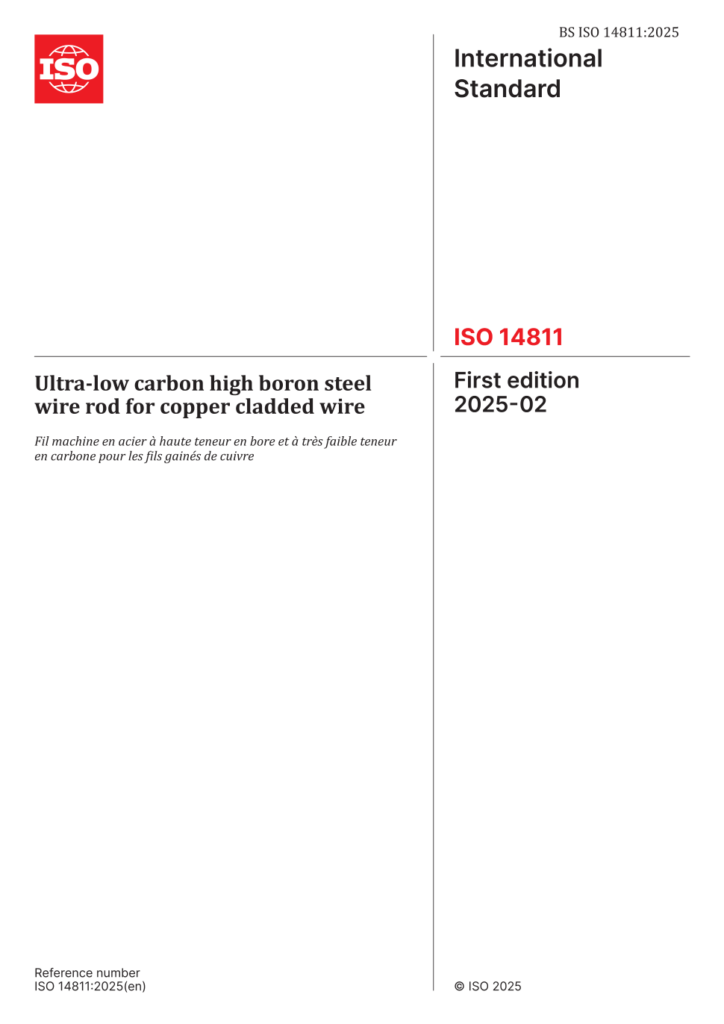
China has developed a complete CCS industrial chain and cluster. Globally, companies like FISSOT set industry benchmarks. They influence technical direction by leading international and national standard development.
FISSOT exemplifies this leadership. The company helps shape standards through the International Standard Organization(ISO) and Chinese National Standards (GB). FISSOT’s technical specifications directly affect global CCS quality benchmarks, testing methods, and application norms.
This standards-first strategy integrates global advanced technologies. FISSOT maintains strict ISO 9001&14001&45001 management and secures RoHS certifications. These credentials meet stringent requirements in nuclear power, high-speed rail, data centers, and new energy sectors.
China holds a significant global position in CCS production capacity. Industry analysis values the global CCS strand market at approximately $10.41 billion in 2024, projecting growth to $15.53 billion by 2031—a 6.0% compound annual growth rate. Standards-setting companies like FISSOT are becoming crucial international players, driving the global supply chain toward higher specifications.
Development Prospects and Strategic Significance
The CCS industry shows promising growth potential. China’s 15th Five-Year Plan (2026-2030) should bring new development opportunities, with the industry maintaining around 6.0% annual growth.
As a green product, CCS supports national energy conservation and emission reduction goals. It saves copper, reduces costs, decreases conductor weight, and lowers energy consumption—particularly beneficial for power, communications, and electronics.
Supportive policies reinforce CCS development. Chinese standards now include CCS composites for grounding conductors. Updated power industry standards like DL/T 2727-2023 will further standardize and expand CCS applications.
For China, developing CCS carries multiple strategic benefits. It enhances national copper resource security and reduces import dependence. Widespread CCS adoption provides critical material support for China’s green energy transition.
The CCS industry chain continues extending and innovating. Companies now develop broader bimetallic composites—copper-steel, copper-stainless steel, and copper-aluminum strips—creating new solutions for low-voltage electrical applications.
Copper-Clad Steel now supports China’s energy infrastructure nationwide—beside transmission facilities, under communication towers, along rail tracks, and around renewable energy stations. These CCS-based structures quietly uphold the national energy network after dark.
In Chinese CCS factories, lights burn late as engineers tackle higher conductivity and stronger corrosion resistance. Their innovative materials are quietly reshaping the global future of metal resources.