
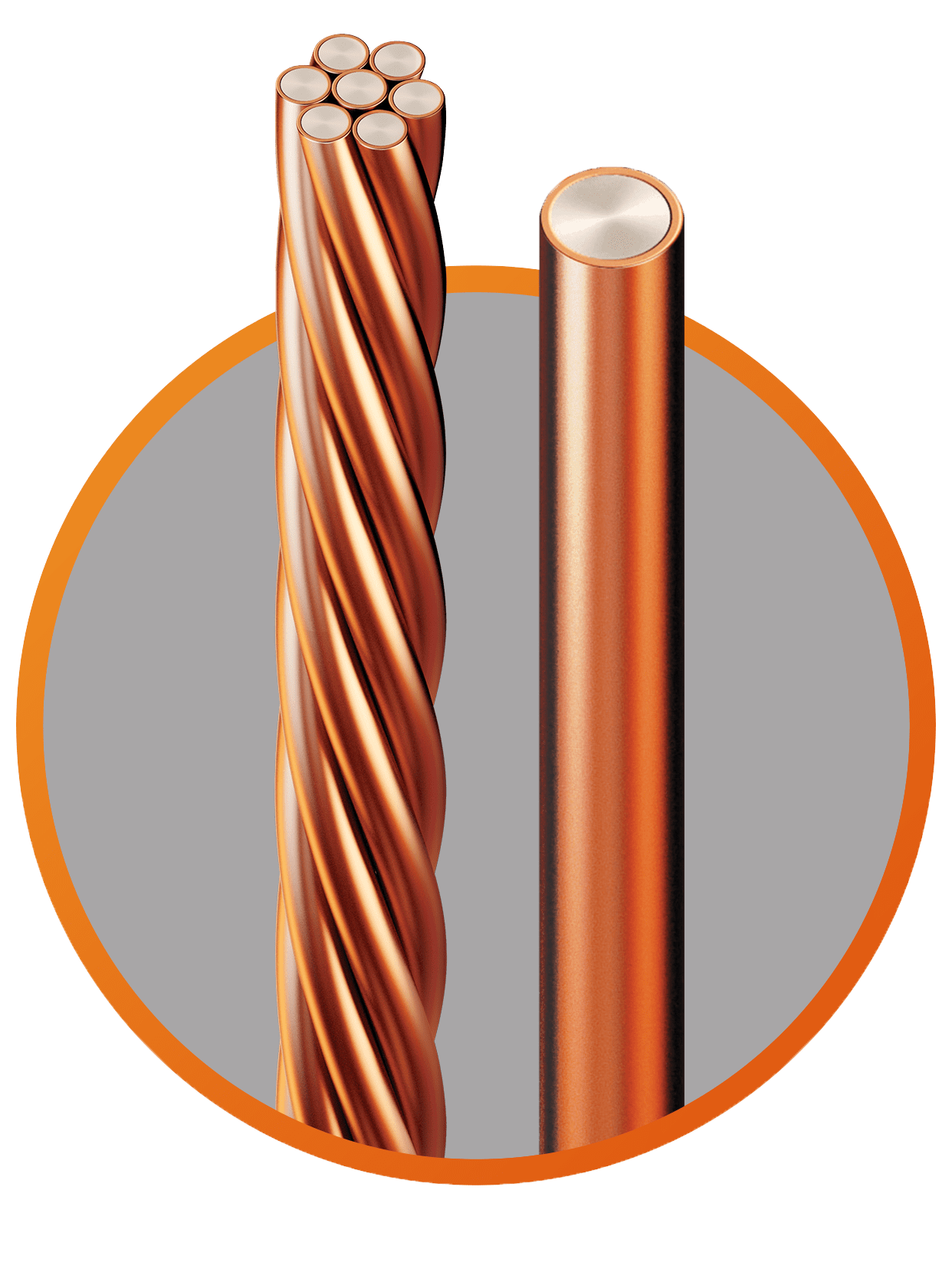
Copper Clad Steel (CCS) Wire
Copper Clad Steel (CCS) Wire combines copper's conductivity with steel's strength. It's vital for electrical grounding, telecom cables, and RF shielding in audio/video gear. Its properties also benefit ABS brake lines, aerospace, and medical equipment components, enabling lighter, durable designs in devices like cameras, TVs, phones, and laptops.
Strength offered
Low carbon, High srength, Extra high strength
IACS
21% – 55%
Size availbale
0.06mm – 6.54mm
Package
Wire will be loaded on steel spool with 100kgs, 300kgs, 500kgs,750kgs per unit and put on plywood pallets which is suitable for sea transportation.
| Nominal Diameter (mm) | Mass per unit length (kg/km) | DC resistance per unit length (Ω/km) 20°C | Min. Breaking load (N) | ||||||
|---|---|---|---|---|---|---|---|---|---|
| 21% IACS | 30% IACS | 40% IACS | 21% IACS | 30% IACS | 40% IACS | 21% IACS | 30% IACS | 40% IACS | |
| 2.00 | 25.03 | 25.18 | 25.59 | 22.90 | 18.30 | 13.73 | 1256 | 1099 | 2591 |
| 1.81 | 20.50 | 20.63 | 20.96 | 27.90 | 22.40 | 16.76 | 1028 | 977 | 900 |
| 1.63 | 16.62 | 16.73 | 17.00 | 34.40 | 27.60 | 20.66 | 834 | 793 | 730 |
| 1.50 | 14.08 | 14.17 | 14.39 | 10.60 | 32.50 | 24.41 | 706 | 671 | 618 |
| 1.20 | 9.01 | 9.07 | 9.21 | 63.50 | 50.90 | 38.14 | 452 | 426 | 396 |
| 1.02 | 6.51 | 6.55 | 6.66 | 87.90 | 70.40 | 52.77 | 326 | 310 | 286 |
| 0.90 | 5.07 | 5.10 | 5.18 | 113.00 | 90.40 | 67.78 | 254 | 242 | 248 |
| 0.81 | 4.10 | 4.13 | 4.20 | 139.00 | 112.00 | 83.68 | 206 | 196 | 180 |
| 0.75 | 3.52 | 3.54 | 3.60 | 163.00 | 130.00 | 97.61 | 176 | 168 | 155 |
| 0.63 | 2.48 | 2.50 | 2.54 | 231.00 | 185.00 | 138.30 | 124 | 118 | 109 |
| 0.50 | 1.56 | 1.57 | 1.60 | 366.00 | 293.00 | 219.60 | 78 | 75 | 69 |
| 0.40 | 1.00 | 1.01 | 1.02 | 572.00 | 458.00 | 343.20 | 50 | 48 | 44 |
| 0.30 | 0.56 | 0.57 | 0.58 | 1017.00 | 814.00 | 610.10 | 28 | 27 | 25 |
| 0.25 | 0.39 | 0.39 | 0.40 | 1464.00 | 1173.00 | 878.50 | 19 | 19 | 17 |
| 0.20 | 0.25 | 0.25 | 0.26 | 2288.00 | 1830.00 | 1372.60 | 12 | 12 | 11 |
| 0.18 | 0.20 | 0.20 | 0.21 | 2824.00 | 2260.00 | 1694.60 | 10 | 10 | 9 |
| 0.17 | 0.18 | 0.18 | 0.18 | 3166.00 | 2533.00 | 1899.80 | 9 | 9 | 8 |
| 0.16 | 0.16 | 0.16 | 0.16 | 3574.00 | 2860.00 | 2144.70 | 8 | 8 | 7 |
| 0.10 | 0.06 | 0.06 | 0.06 | 9150.00 | 7321.00 | 5490.50 | 3 | 3 | 3 |
FAQs About Copper-Clad Conductor
What the advantage of Copper-Clad conductor?
Copper-Clad Conductors provide a more economical alternative to pure copper while maintaining the necessary electrical properties. Additionally, they offer enhanced adaptability to different environments, making them suitable for various industrial applications.
How does the conductivity of copper-clad conductors compare to pure copper?
The conductivity of copper-clad conductors is lower than that of pure copper. However, in specific applications, such as high-frequency transmission, the skin effect allows copper-clad aluminum wire to perform similarly to pure copper wire.
Which conductor is recommended for underground applications requiring high tensile strength in a thin wire?
Copper-clad steel (CCS) wire is the ideal choice. It offers a tensile strength of over 750 N/mm², ensuring durability while allowing for a smaller cross-section.
What is a suitable option for grounding cables in a high-voltage display room that need to be both cost-effective and visually appealing?
Copper-clad steel (CCS) wire offers a cost-effective solution with durability and sufficient conductivity. Its metallic finish enhances appearance, ensuring suitability for these applications.
What is a cost-effective alternative to pure copper conductors given the rising copper prices?
Copper-clad aluminum (CCA) wire offers a practical solution. A wire with 10% copper content can achieve 63% IACS conductivity, providing significant cost savings of up to 70% while maintaining the necessary electrical performance.
We need a conductor for power transmission, but copper is too heavy, and aluminum alone does not provide sufficient conductivity. What is the best option?
Copper-clad aluminum (CCA) wire is a well-balanced solution. With 10% copper content, it weighs only 27% of a pure copper wire while retaining 63% IACS conductivity. If a higher conductivity level is required, the copper proportion can be adjusted accordingly.
 English
  Chinese
  Spanish
  Russian
  Japanese
  Turkish